

The risk of using free or consumer tools for business tasks

Many smaller operations reach for no-cost personal apps or household-grade software to complete everyday work. The appeal is obvious: zero upfront cost and familiar interfaces. Yet these choices carry hidden limits and exposure that everyday users and decision makers often overlook. Enterprises based in the mid-north coast region of New South Wales gain steadier results when business tasks stay on tools built for that purpose.
Shifts in tool selection habits
Work once relied on software bought and installed for the organisation. Today a wide range of no-cost options appears only a few clicks away. People turn to them for file sharing, design, messaging or document editing because they feel quick and simple. The pattern spreads quietly across phones and laptops.

Reasons the practice creates exposure

Personal versions usually lack the controls, recovery options and support that business work requires. Files may sit under an individual’s account rather than the organisation’s. Storage limits appear without warning. When someone leaves, important material can become hard to retrieve. Decision makers then face gaps that cost time and money to close.
Clear explanations of central ideas
These distinctions become useful once applied to the actual tasks people already perform.
Consumer-grade tools are products designed mainly for home or personal use.
Business-grade alternatives include features such as central administration, shared ownership of files and reliable recovery.
Account separation means keeping work material under organisation-controlled logins rather than private ones.
Approaches matched to different operations
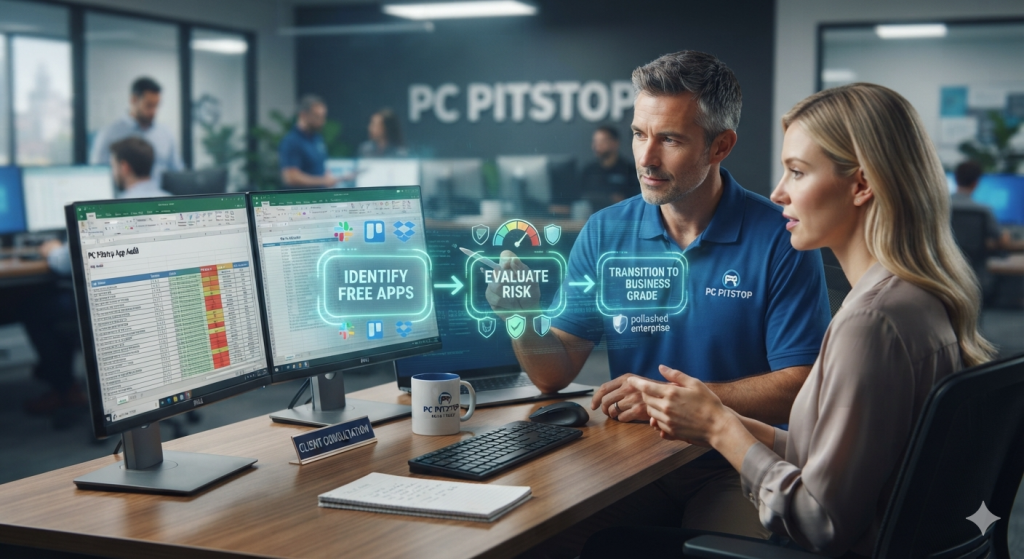
Some firms start by listing the no-cost apps currently in daily use. Others introduce approved business alternatives for the highest-risk tasks first. A few set simple rules about where client or financial material may be stored. The practical approach depends on how many people rely on these tools and how sensitive the work is.

Results for the wider organisation

When tasks move onto suitable tools, ownership of files stays clear. Recovery becomes possible when something goes wrong. Decision makers gain better visibility of where work actually happens. Daily activity continues with fewer interruptions and stronger continuity.
Help supplied by PC Pitstop
PC Pitstop assists local enterprises in reviewing current tool choices and selecting practical business-grade options. We focus on clear recommendations that match the size and pace of smaller operations. Support covers both the review stage and the steady transition that follows.

Still running key tasks on personal-grade apps?
Drop into our store and talk with us about Technology Consulting. We will review the tools your people currently use and recommend practical business alternatives that remove the common limits and gaps. One visit gives you a clear, workable path forward.